How big is a boxing ring? There is no standard ring size in boxing. The dimensions vary depending on the association, venue and type of fight.
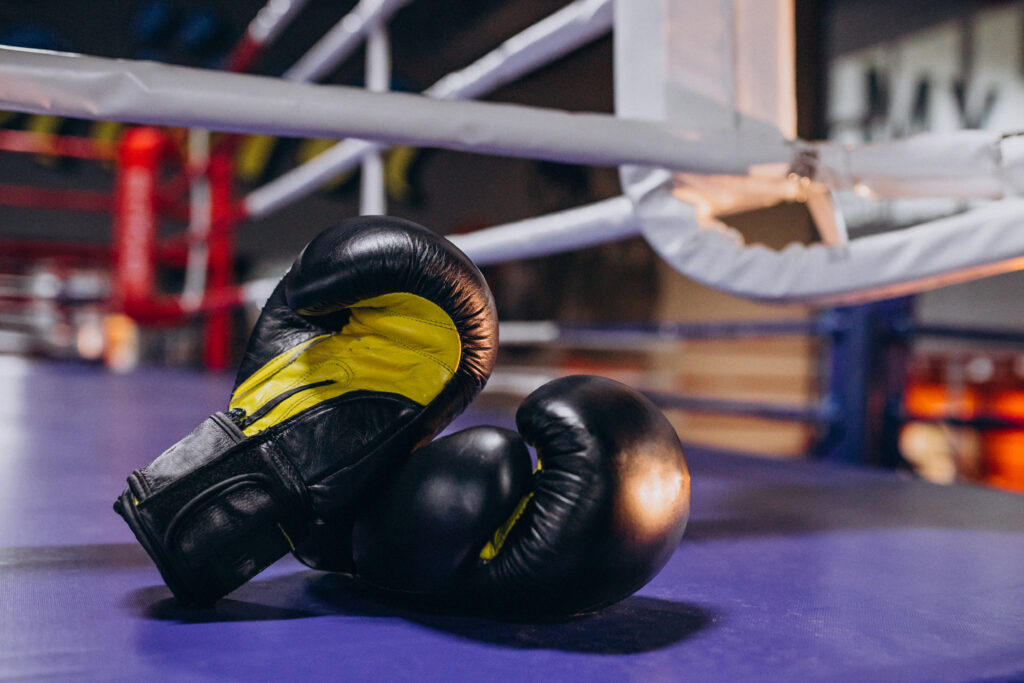
The ring size in boxing has developed over the course of history for practical and safety reasons. Originally, spectators formed a circle around the fighters, coining the term “ring”. In 1838, the London Prize Ring Rules introduced a square ring with ropes to set clear boundaries and increase safety.
There are slight differences in ring sizes in different countries and regions, but these usually follow international standards. The dimensions vary depending on the association and event, but remain within defined minimum and maximum sizes. This standardization facilitates the organization of international competitions and ensures uniform conditions.
Ring size in boxing: the measurements at a glance
The dimensions of a boxing ring range from 4.9 x 4.9 meters (16 x 16 feet) to 7.3 x 7.3 meters (24 x 24 feet). The typical dimensions differ between amateur and professional boxing rings:
- Amateur boxes: minimum size 4.9 x 4.9 meters (16 x 16 feet), maximum 6.1 x 6.1 meters (20 x 20 feet).
- Professional boxes: Mostly 6.1 x 6.1 meters (20 x 20 feet), maximum up to 7.3 x 7.3 meters (24 x 24 feet).
The overall dimensions of the ring, including the ropes, are larger. A standard ring for professional matches can take up to 9.75 x 9.75 meters (32 x 32 feet) of space. It remains more compact for amateur events. The height also varies: The ring floor is often between 91 centimeters (3 feet) and 1.22 meters (4 feet).
Who determines the ring size for a boxing match?
The decision on the size of a boxing ring lies with several parties. World Boxing, the international boxing association, specifies the dimensions of the boxing ring in its competition rules. Accordingly, the ring should have a square shape with a side length of between 4.9 meters (16 feet) and 6.1 meters (20 feet). The German Boxing Association (DBV) bases its ring sizes on these international standards. The internal dimensions of a boxing ring for amateur competitions should be between 4.9 x 4.9 meters (16 x 16 feet) and 6.1 x 6.1 meters (20 x 20 feet). These specifications ensure the safety of the athletes and fair competition conditions.
Ring size in professional boxing
In professional boxing, the rules of the respective boxing associations WBC, WBA, IBF and WBO specify minimum and maximum sizes. Within these specifications, the organizer, usually the promoter, decides which ring size is used. The choice depends on factors such as the space available, the budget and the strategy of the fighters. For big fights, the dimensions can even be part of contract negotiations. However, the final responsibility lies with the local sports commission to ensure that the specifications are adhered to. Whether large or small, the ring size is carefully planned to provide fair conditions for the fighters.
The number of ring ropes
In both Olympic boxing and professional boxing, a boxing ring is equipped with four ropes. These ropes are evenly distributed along the four ring posts. They serve to ensure the safety of the athletes by clearly demarcating the ring and preventing boxers from falling out of the ring. The tension and position of the ropes are precisely defined in the rules and regulations to ensure optimum competition conditions. This principle applies uniformly to the leading professional boxing associations WBA, WBC, IBF and WBO as well as to the international association World Boxing.
How the size of the ring affects the strategy
The size of the ring influences the course of the fight. Boxers make contact more quickly in small rings. This promotes an aggressive fighting style. Large rings, on the other hand, offer more space for defense and movement. Agile boxers benefit from larger rings as they can play to their strengths better.
Ring size in boxing: flexibility instead of standard
The variety of ring sizes has advantages. Organizers can adapt the ring to their needs. Boxing fans experience different dynamics as a result. Whether compact or spacious: ring size remains a key issue in boxing.

Now in BOXSPORT 06/25:
Shields, Taylor, Serrano & Co. – who are the best “Pound for Pound“? And where does the German undisputed champion Tina Rupprecht stand in the ultimate ranking? Plus: 25-year-old Devrim Gökduman has fought his way to the top of the national lightweight rankings. Plus: Junto Nakatani was long overshadowed by P4P superstar Inoue – Japan’s quiet boxing sensation now has a place in the limelight himself. And: BOXSPORT on the steep rise of the Fundora siblings. Plus lots of stories, analysis, rankings, fight reports and much more.