The Asian Boxing Confederation (ASBC) votes against joining World Boxing at its congress – and in favor of remaining in the IBA. Is boxing in Asia facing a crucial test?
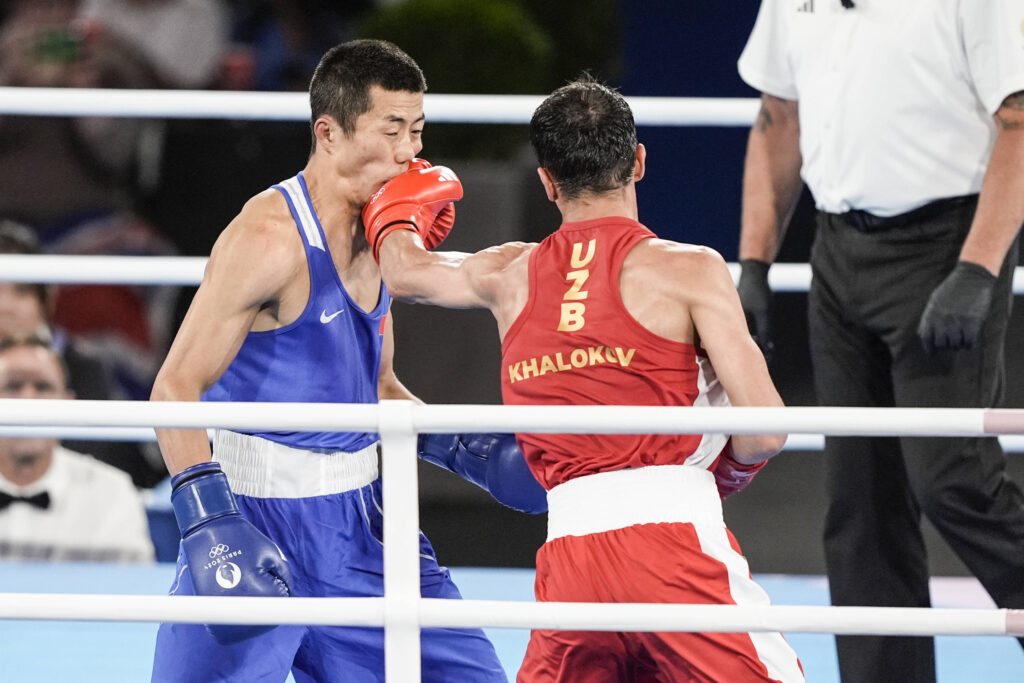
They have decided, the delegates, by a majority. In favor of the Asian Boxing Confederation (ASBC) remaining in the IBA, the International Boxing Association. However, this does not mean that everything is settled. On the contrary, despite all the “unity rhetoric”, the ASBC is in danger of being torn apart.
The ASBC met on Saturday afternoon for its Extraordinary Congress. Parallel to the “Asian Junior & Schoolboys & Schoolgirls Boxing Championships” in Al-Ain, United Arab Emirates (UAE). Delegates from 36 of the 42 member associations of the ASBC were present, following the call of the Board of Directors and its President Pichai Chunhavajira from Thailand. A secret vote was to be held on whether the ASBC should join World Boxing (WB) – and consequently whether it should leave the IBA. The vote: 21 ASBC federations voted against, 14 in favor with one invalid vote.
The background is well known: The International Olympic Committee (IOC) suspended the IBA and former AIBA in 2019 due to allegations of manipulation, corruption and lack of transparency, and excluded them in 2023. As a result, individual national boxing associations founded the WB, including the German Boxing Association (DBV). The aim of the WB is to succeed the IBA as the international umbrella organization for Olympic boxing and to host tournaments at the Olympic Games in the future.
Democratic majority
Interested parties were able to follow the ASBC Congress via livestream. The officials met for more than two and a half hours in the Grand Ballroom of a 5-star hotel in Al-Ain. Secretary General Ali Salameh chaired the congress. Not without complications. Following the naming of delegations present and absent, an open debate began. Several representatives – for example from Uzbekistan, Tajikistan, but also from Sri Lanka and Malaysia – emphasized the unity of boxing in Asia. Then things got serious. Vote.
Salameh called the respective heads of delegation forward to the stage with the ASBC board and handed them a small ballot paper. Beforehand, he said: “Voting is very simple, either check the box marked ‘yes’ or the box marked ‘no’.” The voters then disappeared with their ballot papers behind a pitch-black partition, towards the high table as a writing surface for marking their crosses. They then emerged from the screen again, folded the ballot paper several times and dropped it into an oval, transparent glass jar that stood to the right of Chunhavajira and Salameh’s table. They did this 36 times.
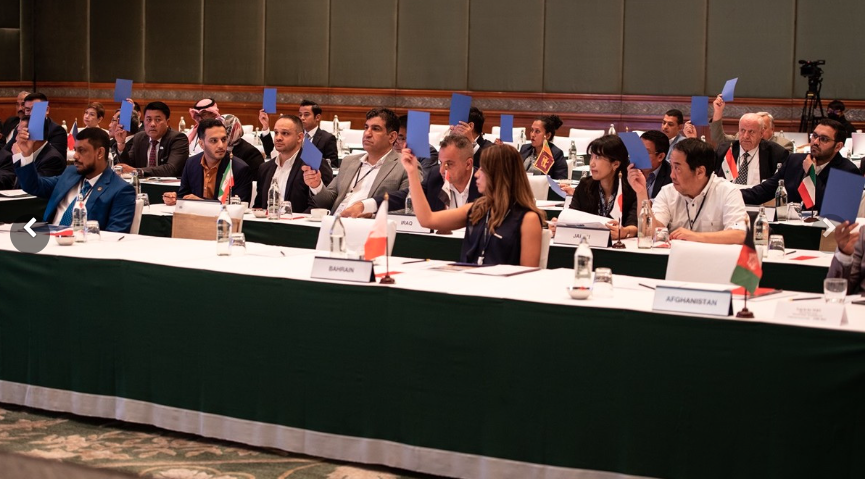
Tension is part of the seriousness, in this case the counting. With the stream running, Salameh took the ballot papers out of the jar, smoothed out the creases and placed them in bundles on the table. He then showed each ballot paper in turn to the camera and announced either “No” or “Yes”, depending on what the ASBC delegates had marked. To illustrate this, a minute-taker kept a “yes-no” tally sheet by hand in black felt-tip pen on a snow-white DIN A0 sheet, fixed to a flipchart on rollers.
As a result, almost 60% of the member associations present voted in favor of remaining in the IBA. Well, the ASBC President and some delegates didn’t seem to think it was that clear-cut. The Secretary General felt compelled to repeat the vote to the congress participants two or three times. Salameh: “It is clear that the motion has been rejected.” Determined democratically.
Association independence option
Nevertheless, not everyone was willing to accept the decision. The president of the UAE association, Anas Alotaiba, tabled another motion. The ASBC should declare itself independent, become an autonomous organization and not belong to either the IBA or the WB. At least for the time being. The Executive Board put this “motion” to the vote by a show of hands. First Salameh counted 16 arms, then 19 when they counted again. Salameh and Chunhavajira nodded to each other and said almost synchronously: “Majority.” Nominally yes, but not according to the statutes.
Because: For new agenda items that were not initially on the congress agenda, at least a two-thirds majority was required, intervened the ASBC Vice-President and head of the Kazakh Boxing Federation, Aziz Kozhambetov, from the lectern. With 36 delegations, 24 would have to agree. The quorum had not been reached with 19 votes in favor, so the motion to end the discussion was null and void. Salameh had to admit the mistake and so the extraordinary congress ended with Chunhavajira’s closing remarks and thanks to the participants.
IBA urges to prudence
Only a short time later on Saturday afternoon, the IBA issued a statement welcoming the ASBC remaining in the “family” of the International Boxing Association. “A democratic decision by the delegates of the Congress.” The IBA also warned dissident national ASBC federations to proceed with caution, as a potential withdrawal would mean they would not be able to return.
This made little impression on one person. Chunhavajira announced his resignation from the IBA Board of Directors on Saturday evening via ASBC’s Instagram. “In light of the decisions made today,” said Chunhavajira, who apparently wants to remain ASBC President. Chunhavajira noted that the Asian association was at a “crossroads”. The focus must be on ensuring that boxing remains on the Olympic program in Los Angeles in 2028. Translated, this probably means that this can only succeed with World Boxing. This may be true, but it does not mean that the ASBC has been spared another test. On the contrary.
Text: Oliver Rast