BOXSPORT looks back on the impressive career of Regina Halmich, who also had to fight for herself and her sport outside the ring – against her male colleagues, her promoter, her parents, television and Stefan Raab.

Three Hall of Fame years will be honored at the 2022 induction ceremony in Canastota. Alongside other ring idols such as Floyd Mayweather jr., Bernard Hopkins and Roy Jones jr. in the circle of honorees: Regina Halmich. The German boxing queen is one of only three women to be inducted into the International Boxing Hall of Fame. In 2020 it was Christy Martin and Lucija Rijker, in 2021 Laila Ali and Ann Wolfe, this year Holly Holms and Halmich.
The only German boxer to make it into the Hall of Fame before Halmich: Max Schmeling. Asked by BOXSPORT whether the Hall of Fame took too long to induct women into its ranks, Halmich replied diplomatically: “Of course you can discuss whether it’s too late. But I say: better late than never. And it’s nice that everything still ends so well, especially in my career. I can see what my work and the groundwork I did for women’s boxing was good for, because we can see where women’s boxing is now.”
The path to the top is a rocky one, in which the boxing pioneer has to overcome some resistance. Halmich originally came to martial arts through a friend who took her to karate training. The student was quickly hooked. “I was already very enthusiastic about it back then. That’s how Jürgen Lutz, who was my karate coach at the time, discovered me and then got me into kickboxing. There he saw that I was particularly good with my fists,” she says of her early days at the Bulldog Gym in Karlsruhe. Her former idol is now a Hall of Fame colleague: Lucia Rijker, who was an undefeated kickboxer from 1982 to 1994 and switched to “Sweet Science” in 1996.
Halmich: “An experiment”
Halmich’s parents were far less enthusiastic than her offspring. “My parents thought karate was good for self-defense, but they were suspicious of kickboxing, they thought it was brutal,” she recalls. At first, the young fighter sneaked over from karate to kickboxing training, but later she negotiated a deal with her parents. “The only condition was that I did well at school. I was basically only good at school so that I could go to training. That was a good compromise,” she recalls with a laugh.
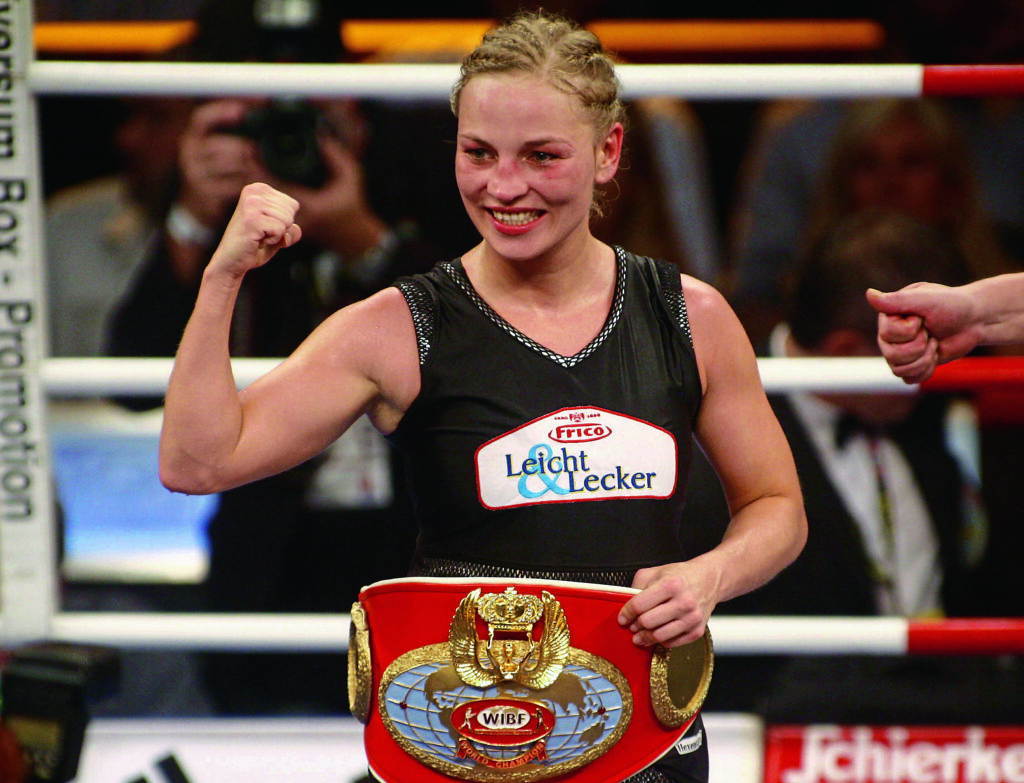
Halmich also trained as a paralegal at the request of her parents, who wanted a solid professional foundation for their daughter. “At that point, I already knew that I wanted to become a professional boxer,” she explains. She completed her first professional fights parallel to her training, six of them in her first year in 1994 alone, five of them in her home town of Karlsruhe. Halmich wins her first eight fights, including an away match in Italy. At this time, the major world federations were not yet interested in women’s boxing, and Halmich’s mentor Jürgen Lutz co-founded the most important women’s federation in 1989: the WIBF. Halmich got her first world championship opportunity there on April 20, 1995, when she was allowed to compete for the flyweight world championship against the American Yvonne Trevino at the Aladdin Hotel & Casino in the boxing mecca of Las Vegas.
Key experience in Halmich’s career
The fight was to be the first and only defeat of her professional career, as Halmich had to retire after four rounds due to a cut on her left cheek. The early end to the fight, in which both opponents had to enter the ring dust in the first round, also had to do with the equipment. “Back then, we were still boxing with those Reyes gloves with horsehair padding. That’s forbidden nowadays. But out of seven women’s boxing matches in Las Vegas, six ended in knockouts that evening,” recalls Halmich. “The gloves were as hard as concrete. You could see that with my opponent too: when she hit me in the head with a punch, she broke her hand. One more round and she would have been the one to retire.” However, it was Halmich who was sent off the ropes by the referee, even though she wanted to continue boxing.
She still talks about this moment in her career in lectures today: “This key experience of defeat was incredibly important for me afterwards. I didn’t want to admit it at the time, but I often thought back to it and it motivated me when things weren’t going well in training or I was too sure that I would win. I drew discipline from that, because I never wanted to experience that evening again, it was really bad for me.” In the very next fight after the Trevino defeat, Halmich gets another WIBF chance at the flyweight title. She defeated Kim Messer via split decision. This finally attracts the attention of Klaus-Peter Kohl, then head of Universum Box-Promotion. He takes Halmich on as the first woman in his stable.
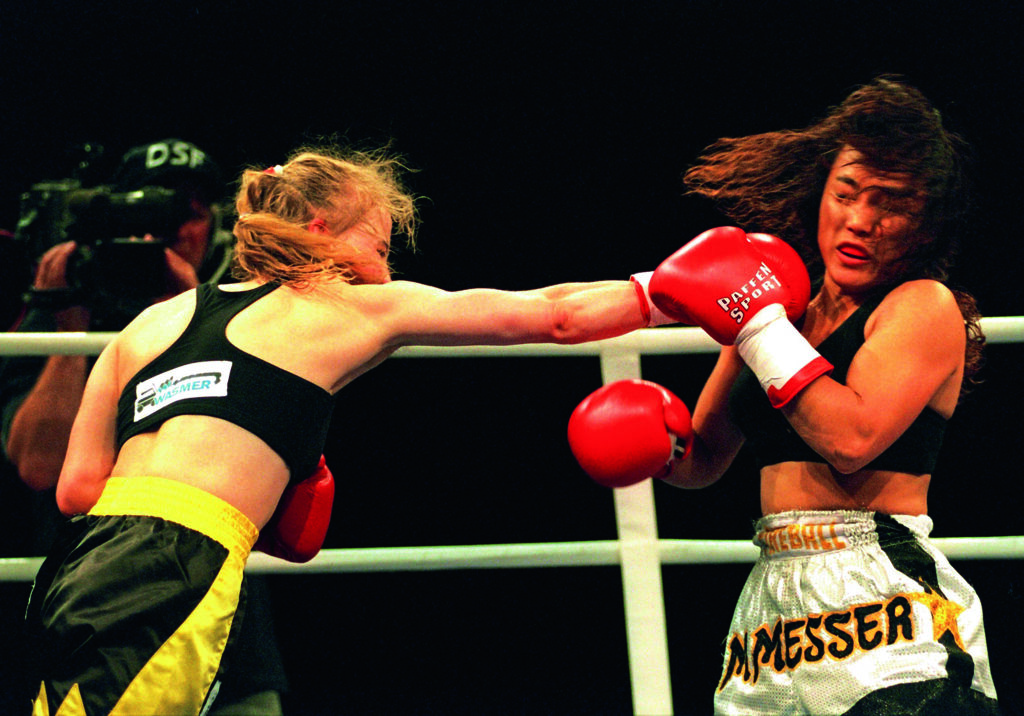
Great skepticism: Halmich must assert herself
The champion has to assert herself in a male domain, because not all of her colleagues are convinced by her. Even her promoter was skeptical at first. “I was basically an experiment and didn’t cost much money, so the risk for Universum was manageable. They tried it out because I went down well with the audience and created a great atmosphere in the hall. Peter Kohl wasn’t yet as passionate about it either. That only developed over time.”
Universum later signed other women such as Daisy Lang and Ina Menzer. No doubt also because Halmich won over her male colleagues with her hard work and commitment. “I had the same training workload as the men right from the start, I never bitched or complained, I didn’t want to be an exception or be treated like a girl, because it was important to me that I had the same training program.” By getting to know each other personally and training together, the young woman impresses her celebrity colleagues and breaks down prejudices against her sport. “Dariusz Michalczewski, Artur Grigorian and the Klitschkos, who joined in 1996, all treated me very, very nicely. They may not all have been friends of women’s boxing, but they were friends of mine.”
Dariusz Michalczewski: friend and idol
Michalczewski, the “Tiger”, is not only one of the most important protagonists of the German boxing boom in the nineties, he is also listed on the boxing queen’s homepage as her sporting idol. “We had the same trainer back then, Chuck Talhami from America. Dariusz was always the first to train, I was second. Nevertheless, I always came to his training sessions in the gym and watched all his sessions. I’ve seen thousands of rounds of sparring from him, I’ve soaked up every training session. He really was my role model because he brought such discipline with him. He was an absolute training beast and I learned a thing or two from him. That’s why he’s not just a friend, but also an idol,” says the former boxer, explaining her choice.
Halmich successfully defends the title she won against Kim Messer twelve times, switching back and forth between super flyweight, flyweight and semi-flyweight, becoming WIBF champion in every limit. She only has to accept a single draw, on September 11, 2004 against Elena Reid. In the rematch on December 3, 2005, Halmich wins unanimously on points.
“We athletes are the last people who want to be given fights for free. It was clear to me that I had to get a rematch right away,” she says of the first Reid fight. “It was incredibly important to me, a question of honor. You can tell yourself when you haven’t performed at your best on an evening, which is why the rematch was so important to me.”
Who was the toughest opponent of her entire career? “There have been some who were really tough, whether in terms of style, punching power or fitness. Elena Reid was certainly a very strong opponent, but also the Spaniard Maria Jesus Rosa, who unfortunately died of cancer recently. I also had world champions in other weight classes in front of my fists, such as Wendy Rodriguez or Delia Gonzalez. There were a few fights that demanded everything from me. Hagar Shmoulefeld Finer in my last fight was also an unpleasant opponent due to her unorthodox style,” is Halmich’s conclusion.
Text by Nils Bothmann
This text was first published in BOXSPORT 06/2022.